Twisty Roads Rally Group
presents:
The Road Not Taken
August 2-3, 2008
GENERAL INSTRUCTIONS
Exception:
Due to unexpected circumstances which might arise during the
event, Rally Officials may instruct you to modify, until further
notice, each CAR ZERO time encountered in the Routebook and on
Checkpoint Slips (such modifications will always be done in whole
minutes).
Note that all car numbers are even-numbered, and all Checkpoints include a two-minute pause.
If
everyone and everything is always exactly on schedule, you will arrive at each
Checkpoint as the car preceding you leaves the Checkpoint, and
you will leave the Checkpoint as the car behind you arrives.
11.
TIME ALLOWANCES
If you are delayed for any reason (flat tire, wrong turn,
navigator stomach evacuation, UFO abuction, school bus, collecting
Sasquatch scat, just feel like
it, whatever), then it is not necessary to make extraordinary effort to
regain the lost time. Your score at each Checkpoint will
automatically have the most suitable SCCA Time Allowance (TA) applied.
It is not necessary to request a TA—the most appropriate TA will automatically be applied.
There are 10 possible TA amounts which can be applied: 1, 3, 5, 7, 9, 11, 13, 15, 17, or
19 minutes. TA's only apply when you arrive at a Checkpoint behind schedule—if
you arrive early, no TA will be applied. If you are delayed, you
should adjust your schedule by one of those number of minutes.
(Those odd-numbered minutes will place your adjusted schedule
midway between other cars' schedules, so cars don't need to occupy the
same place at the same time.)
NOTE: No more
than 19 minutes of TA will be applied at any Checkpoint. If you
are more than 21 minutes behind schedule, you will receive the maximum
Checkpoint score of 200
(2 minutes).
Note:
If
you have a higher car number and are more than 21 minutes late, then a
Checkpoint may have closed and gone away before you arrive (you will
not know when you pass that location). This will not cause
you any penalty or problem, and you must not make any adjustment
to compensate for a missed Checkpoint. Scoring will automatically
adjust if you miss a Checkpoint and its 2-minute Checkpoint pause.
Note:
You may miss a Checkpoint even if you are on schedule, if a Checkpoint
could not be set up in the first place (Checkpoint placement schedules
can be tight, so a small delay can prevent setting a Checkpoint before
first car arrives, in which case the Checkpoint would be
cancelled). If you notice that you've missed a Checkpoint, do not
assume that you have made any mistake, and do not attempt to adjust for
the missing Checkpoint. Just shrug it off. It'll be all
right.
Note:
This probably will not happen to anyone on The Road Not Taken, bu if
you are delayed within view of a Checkpoint crew, and the delay is not
under your control (another vehicle is blocking the road, for example),
then you should proceed into the Checkpoint as soon as safely possible
and submit a TA request for the exact amount (to the .01 minute) of
that delay.
Write the exact amount of at-the-Checkpoint delay on the Timing
Slip in the special place provided, and be sure to give that Timing
Slip to the Checkpoint crew before you take any slips they hand you.
Ask the Checkpoint crew to sign as witnessing the delay.
If the organizers and Checkpont crew agree that the TA request is for
the witnessed amount of delay (reasonably close) and the delay was not
your fault, then your score will be adjusted by the amount you
request.
12.
SECTIONS
The rally consists of about 8 Sections.
The first Section will begin at Event Headquarters, when you
start the rally, and the final Section will end at Event Headquarters
when you finish the rally, the next day. The end location of one
Section is the start location of the next Section.
The CAR ZERO end time of one Section will be some minutes before
the CAR ZERO start time of the next Section--so there will be at
least one minute of pause time between Sections (probably more like at
least 10 minutes in most cases). The start location of
each Section, and the CAR ZERO start time of each Section, will be
clearly identified in the Routebook.
Official mileage will be 0.00 at the start of each Section.
Some Sections, such as the mid-point break Section, will indicate that
they have no Checkpoints, and all speeds listed in the Routebook on those Sections will be in
grey, rather than black, to indicate that they are advisory speeds
only.
Those Sections will allow ample time to complete them, and will
usually allow extra time for a break.
You do not have to worry about being on time while you travel those
Sections—but you do have your scheduled start time for the next Section.
13.
GENERAL ROUTE FOLLOWING PRINCIPLE
At all intersections where your next instruction does not apply,
follow the intuitively obvious road that you are on. There will
be an instruction anywhere any doubt might exist, so you should never
need to slow down and evaluate an intersection in effort to determine
the correct route.
Note:
Differences among vehicles' lighting and middle-of-night visibility on
forest roads can
"play tricks", causing one intersection to seem major to competitors in
one car while being invisible to competitors in another car. The
instructions provide some assistance by shading minor roads, to help
you recognize intersections that might sneak past you. You may find many instructions which you would not need in order to follow the route—but those instructions may be important for others.
It is possible that you might at some point think you are off-course
because you are well beyond the mileage of the instruction that you are
looking for and haven't yet seen. Please
be pretty sure that you really are off-course before you turn around, and
expect on-coming traffic if you do head back—even if you know you are off-course (if you went there, others might). Be
conscious that your
instructions cannot warn you of any hazard you may encounter while you are
off-course (coming back from off-course, you will be eager and believing that you 'know the road', since you just came down it—but
The Road Not Taken roads tend to greatly change character in the
opposite direction, and even in the same direction at just slightly
different speeds. Stay calm, be wary, remember that TA's eliminate the need to catch up the time you spent off-course.
14.
CHECKPOINTS
You will not know the location of Checkpoints until you arrive at them.
In many cases, you will see the Checkpoint Sign only a moment or two
before passing it.
Stay alert.
You must stop at each Checkpoint timing car, and turn in your Timing
Slip, and receive a Checkpoint Slip from the Checkpoint crew.
CAR ZERO spends exactly 2 minutes at each Checkpoint, so if you are
on time then you will have 2 minutes to complete this information exchange.
There is no outpoint or dead mileage at any Checkpoint.
No out-time will be assigned to you at any Checkpoint: other
than the 2-minute Checkpoint pause, you simply "continue yoiur present
speed and course". New feature: The
next instruction following a Checkpoint will include the CAR ZERO time
(and all instructions include mileage), and there will not be another
Checkpoint before that next instruction, so you essentially can use
that next instruction as an outpoint, if you wish. Note:
If you need to pause at that next instruction, be sure to stay safely
out of the way of following rally traffic, which might not pause.
Due to the narrowness of many roads, you may have to block part of the
road when exchanging information at the control car at some Checkpoints.
Such situations will be as few as practical, and very low risk, and
should present no difficulty for anyone.
However, please be alert, behind you in particular, when stopped
at any Checkpoint, and leave the immediate vicinity of the Checkpoint
car as soon as feasible.
Checkpoints may close after all vehicles have passed, or 21 minutes
after the scheduled arrival time of the last contestant, which is when
the last contestant would receive max score even after maximum TA has
been applied.
If a Checkpoint is closed or gone when you arrive, it will have
no direct effect on you, and you can successfully continue without even
knowing that you've missed the Checkpoint. You will be scored the
200 points maximum for that Checkpoint, and the 2-minute Checkpoint
pause that you miss will be adjusted during scoring.
15.
TIMING SLIPS
At the start of the rally, you will receive a stack of two-copy Timing Slips.
Before starting the rally, carefully write your Car Number on all of
your Timing Slips (anonymous or illegible Car Numbers on Timing Slips
will be an unwelcomed problem during scoring).
You must submit a Timing Slip (both copies) to the Checkpoint crew at
each Checkpoint.
Each Timing Slip will have a place for you to record your
declared arrival time-of-night at the Checkpoint, if you wish, before submitting the Timing Slip to the Checkpoint Crew.
On the Timing Slip, the Checkpoint crew will record the
time-of-night that they clocked you as arriving, then give you one copy
of the Timing Slip and a Checkpoint Slip that will disclose the mileage and CAR ZERO arrival time at the Checkpoint Sign.
Note:
All time-of-night listings will be in 12-hour format, with no am/pm
indicators (look out the window and use your judgment).
Checkpoint timing will be to the 1/100th (.01) minute.
A seconds-to-1/100-minute conversion chart will be included in the Routebook.
16.
MID-POINT BREAK
At about mid-point in the event, you will have an extended break at
Spirit Mountain Casino.
There will be opportunity for refueling at Spirit Mountain Casino.
17.
SCORING
At each Checkpoint, you will be scored one point for
each .01 minute difference between the correct arrival time
and your actual arrival time, whether early or late, up to the maximum 200
points (2 minutes) at any Checkpoint.
An additional 100
points will be added to your time penalty at a Checkpoint if you are
determined to have "balked" (unsportsmanly stopped or slowed extremely)
after seeing the Checkpoint sign--except that a balking penalty will
not increase your time penalty beyond that maximum 200 points.
(That's SCCA rules. The
Road Not Taken is not a rule-fudging contest, and we will be awfully
disappointed if we actually have to deal with any nonsense such as
this.)
You win if you have the lowest total number of points for the rally.
If two or more teams have identical total scores, they will
achieve the same finish position. The Sum-Of-Squares method will
be used to determine which team gains actual possession of any physical
objects awarded that finish position.
18.
ROUTE INSTRUCTIONS
See
sample Routebook pages
,
so you can follow along.
The sample page may be a bit funky in
the formatting, due to software conversions: The real instructions will be so much nicer!)
Each instruction consists of one row of 6 boxes, left to right.
The FIRST box, labelled ##, contains the instruction number.
Instruction numbers reset to 0 at the start of each
Section. Instruction 0 will be a shaded reprint of the last
instruction of the previous Section, because a Section starts where the
previous Section ends.
At the bottom of that FIRST box, in light text, is the Section
Number, for instant reference.
Note: The combination of
Section number and instruction number (both of which are printed in
that FIRST box) forms a unique identifier for that instruction.
A !, !!, or !!! appearing over the mileage indicates that that
instruction contains a CAUTION (described later in these General
Instructions).
If a mileage is underlined, it indicates that the instruction contains
more than one mileage reference, because the instruction contains
more than one point of interest.
The additional mileages will be found in the INFORMATION box, where they
will again be underlined.
It'll be clear.
Instruction numbers begin at 1 for each Section (not counting the
reference Instruction #0, which is only a reprint of the last
instruction in the previous Section).
Sections are numbered, beginning with Section 0.
Each page of instructions includes the Section number at the top of the page.
Each instruction in the event can be identified by Section
number-Instruction number.
For example, Instruction 16 of Section 4 can be identified as "4-16".
The SECOND box, labeled MILEAGE, contains two numbers.
Near the
center of the box, in large, bold type, is the Section mileage at which the
instruction must be executed.
Every instruction will include
official mileage—and official mileage is the only official
reference for an instruction.
NOTE
In a few cases, there will be two of these mileages, to indicate
mileages at two significant points in the instruction.
In the lower
right corner of the box, in smaller, lighter type, is the incremental
mileage (distance to the next instruction); and the incremental mileage
box will be shaded if the distance to the next instruction is very short.
The THIRD box, labeled CAST, will usually be empty.
If a number is present in the box, you must change your average
speed to that many miles-per-hour, at that point.
If the first instruction on a page is underlined, it is just a
reminder of what the speed is and has been.
The FOURTH box, labeled PAUSE, will usually be empty.
If a number is present in the box, then stop that many minutes
at somewhere near the mileage shown.
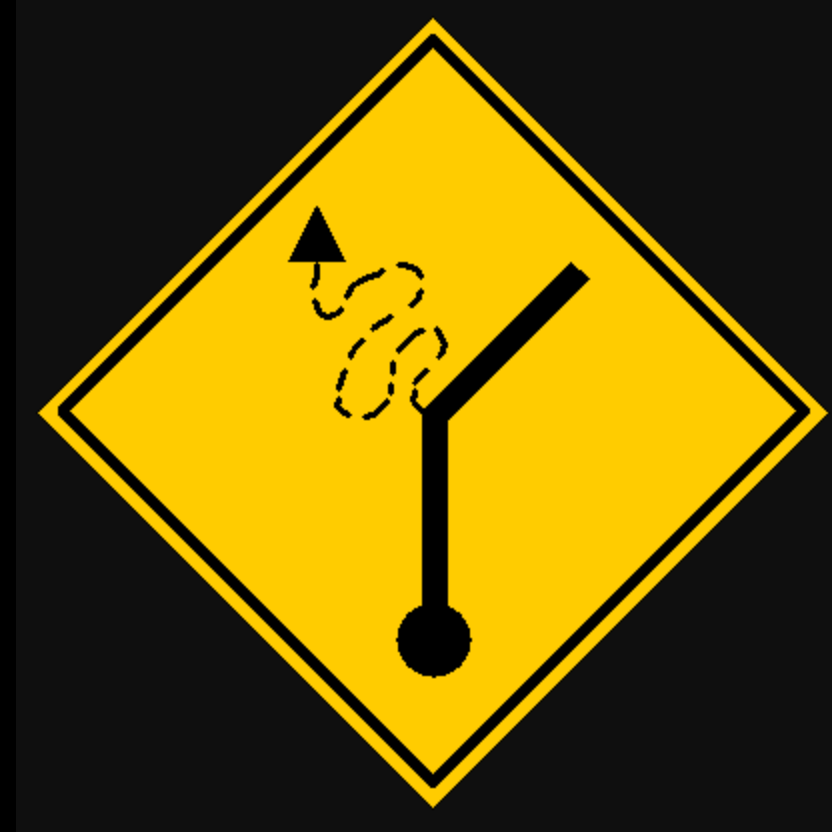
The FIFTH box, labeled TULIP, contains a recognizable representation
of the route at that point.
There will be a large black dot near the bottom, indicating where
you will approach that part of the route, and at some other point
in the diagram will be a large black arrowhead indicating where you
must leave that portion of the route.
If a little dot appears in the diagram, it will indicate approximately where
a specified sign is situated.
A large grey dot indicates something
of note, which will usually be described in the INFORMATION box.
A
thick dotted line alongside the road indicates an area of exposure
(cliffs).
Braces along a road ( ] | [ ) indicate a
bridge.
Other items may be included in a diagram, and should be
obvious without detail here.
On intersections where we're sure the
correct road is obvious because other roads are notably less improved, the
lesser roads sometimes will be shown in grey, rather than black—but you
might not always agree that a grey road is a "lesser" road.
If a
tulip shows only a straight road, and perhaps a sign or hazard, then the
tulip represents
only a couple of feet of the road and—despite the tulip showing a
straight road—the road may actually be in the middle of a corner at
that point (in fact, that's almost guaranteed, since there are no
straight roads on The Road Not Taken).
NOTE
Diagrams are not to any consistent scale.
Don't quibble.
The SIXTH box, labeled INFORMATION, may contain additional information,
cautions, English restatements of the tulip, sign quotes, or other stuff.
Signs will be indicated by quote marks surrounding all-uppercase words
("THUNDER RD", for example).
NOTE
Though intended to be accurate as listed in the INFORMATION box, signs are
not official references, and they may be missing or changed.
Official mileage is always the official reference.
19.
CAUTIONS
In The Road Not Taken instructions, official cautions which warrant unusual
concern will include a ! or !! or !!! designation.
Take them
seriously!!! There are plenty of other hazards along the
route—these are special.
The ! designation indicates a noteworthy hazard which is not too
easy to screw up, or which offers a relatively minor punishment for
screwing up.
Slow down and stay alert!
The !! designation indicates a hazard which is not hard to screw up,
or which offers significant punishment for screwing up.
Slow way down and be real careful!!
The !!! designation indicates a hazard which is easy to screw up,
and which offers severe, possibly life-threatening, punishment if you
do screw up.
Slow way the heck down to almost crawl speed and be severely cautious!!!
CAUTION The instructions and cautions were all
designed to work at approximately the specified average speeds, and are
intended to be useful to less skilled competitors in everyday cars.
Veteran competitors in performance rally cars will likely find
many--but not all--cautions to be unnecessary. If a caution
appears to have no real basis, trust that you simply are not seeing
what really is there. Do not dismiss a caution (until you are
past it)--we did not generate the cautions by throwing darts at a map.
There is a
special consideration on The Road Not Taken. A ho-hum speed is
usually pretty near the oh-oh speed. There typically is very
little room to fix an oh-oh, so "oh-oh" and "oh-shit" are often
synonymous on this event. The cautions do consider that someone
might be trying to catch up a little time when they approach the
caution point--but they do not cover the Whole Different Picture you
would see if you were so foolish as to attempt to make up a lot of time
quickly.
20.
MEASUREMENT AND MILEAGES
NOTE: If you are not competing with a rally computer, or are
otherwise freaky about the "gnat's butt" details, then you won't need
to memorize this stuff; however, you would be foolish to not carefully
read it at least once.
Official measurement is not scheduled until after these General
Instructions are printed.
Details of official measurement vehicle, conditions, etc., will be
posted at Registration at Event Headquarters, with copies available
on request.
Correct arrival times are computed by the method specified by
SCCA regulations.
On each instruction, the mileage is at the beginning of the
first intersection, if there is one.
If the diagram shows no intersection but does indicate a sign or
distinct landmark, then the mileage is at the beginning of the
sign or landmark.
If neither intersection, nor sign, nor distinct landmark is shown
in the diagram, then the mileage is at the approximate beginning
of the diagram.
If more than one intersection, sign, landmark, or combination thereof
is shown in a diagram, there might be two mileages listed.
Your odometer may differ quite a bit from official mileage; the
first Section of the rally will be suitable for determining that difference.
Be aware that wheelspin and other variables may cause stock
odometers to "wander" considerably.
The zillions of snug unpaved corners on The Road Not Taken offers
challenge for even the best electronic rally odometers.
21.
SPEEDS
Specified speeds are "average" speeds.
You will not be able to always drive at the specified speeds,
because you will have to slow for corners, hazards, and difficult
stretches of road.
Therefore you will need to drive a little faster, where safely
possible, in order to compensate for the slow-downs, so that you arrive
at Checkpoints as if you had travelled constantly at the exact
specified speeds. A steady pace (not the same as "steady speed")
will safely serve you well. Avoid chasing things around--instead,
adjust your pace.
Understand that the ability to maintain a specified average speed depends on
many factors, such as the type of car, the type of tires, the condition of
the car, the condition of the tires, driver experience, driver skill, driver
condition, quality of lighting, weather, road surface condition, and so on
and on.
Particularly on The Road Not Taken, minor differences in
one of these factors can make a large difference in how easy it is to
maintain the specified average speeds.
Don't attempt to drive at
the specified speeds when you cannot safely do so.
If
the specified average speeds are consistently too fast for you to safely
maintain, then complain to us at the end of the event—but
don't drive at speeds you cannot safely maintain.
22.
EXPOSURES
Most of The Road Not Taken course runs along mountainsides, so you
will usually be driving with a steep bank on one side of the road and a
steep drop-off on the other side.
The term, "exposure" describes where at least one side of the
road is open and has a significant drop-off.
The term, "hidden exposure" describes where at least one side of
the road has a significant drop-off that is not readily apparent, due
to roadside shrubbery or heavy forest. (The bases of roadside trees are
often 10-20 feet below the road, on a steep bank; and a "wall of
shrubbery" along the outside of a corner often is a remarkably thin and
flimsy curtain which is blocking an expansive view).
Exposure, either hidden or open, is almost constant through the
entire course.
We've noted in the instructions some of our favorite exposures
and hidden exposures, but it would be pointless to attempt to note all
of them.
Summary: It is imperative that you stay on the road.
In addition to exposures, the road edges throughout the course are
slick, abrupt, infirm, booby-trapped. They are "the embodiment of evil". Shun them.
23.
FOREST FIRE HAZARD AND OTHER ENVIRONMENTAL CONCERNS
Fire hazard is generally very high this time of year, regardless of
current weather.
Be real careful. Don't start nothing.
24.
SWEEP VEHICLES
The Road Not Taken will run at least one sweep vehicle, on a
schedule shortly behind the last competitor's schedule. The sweep
vehicle may be able to provide minimal basic assistance, and will be
able to communicate with Headquarters.
25.
WILDLIFE HAZARDS
Abundant wildlife, in considerable variety, lives on The Road Not Taken.
The noteworthy risk is collision with deer or elk.
Deer will generally be seen alone or as a family of 2-4.
Elk—which are generally bigger and heavier than your
car, or truck—tend to stay in large herds; and those herds like to
cross roads in long single-file chains that refuse to be disrupted.
If you see an elk, be very alert for others.
26.
NON-RALLY TRAFFIC
Most of the route will of course be on less travelled roads; however, the
roads will be open to public two-way travel, and you will encounter oncoming
traffic.
Please drive with headlights on even in daylight (to give
others half a chance, you know).
Be alert.
By all means
be very courteous—an annoyed citizen can be a real bad thing
for this event and future events.
27.
HOW TO QUIT THE RALLY BEFORE FINISHING
If you disappear, we will search until we find you.
If you are unable to complete The Road Not Taken, you must notify
a Checkpoint crew or other rally official.
If at all feasible, please also check in at Event Headquarters, so
that we are certain that you have safely made it back to civilization.
28.
PASSING AND BEING PASSED
If you notice a vehicle closing from behind you, do what you can to let the
car get by you as soon as safely possible.
If you approach a car
from behind, stay back a safe distance and be patient—make good use
of your TA's.
29.
MOTION SICKNESS
This event challenges one's motion-sickness tolerance.
More than one "I-Never-Get-Carsick" navigator have lost their title on The Road Not Taken.
If you have any doubt or concern, it might be wise to take
preventatives before the start of the event (preventatives typically do little once the first symptoms appear).
30.
IF YOU BELIEVE YOU ARE OFF-COURSE
| GENERALS SECTION | SCCA ARTICLE | EXCEPTION TOPIC |
| Section 5 | Article 9 | Pre-start contestant meeting. |
| Section 9 | Article 9 F | Routebook dispersal time. |
| Section 11 | Article 21 B | Time allowance increment. |
| Section 13 | Article 23 B 1 | Reference to dead-end, etc., roads. |
| Section 13 | Article 22 C | Intuitively obvious principal roads. |
| Section 13 | Article 22 D | Off-course stoppers. |
| Section 14 | Article 16 C | Format of Checkpoint signs. |
| Section 14 | Article 16 H | Checkpoint close times |
| Section 18 | Article 23 A 1 b | Instruction numbering. |
| Section 18 | Article 23 A 4 e | Mileage placement. |
| Section 18 | Article 17 D 1 | Distance between instructions. |
| Section 20 | Article 17 C | Time of posting measurement details. |
| Section 38 | Article 13 C 2 | Required equipment. |
| Section 39 | Article 16 L | Observation controls. |